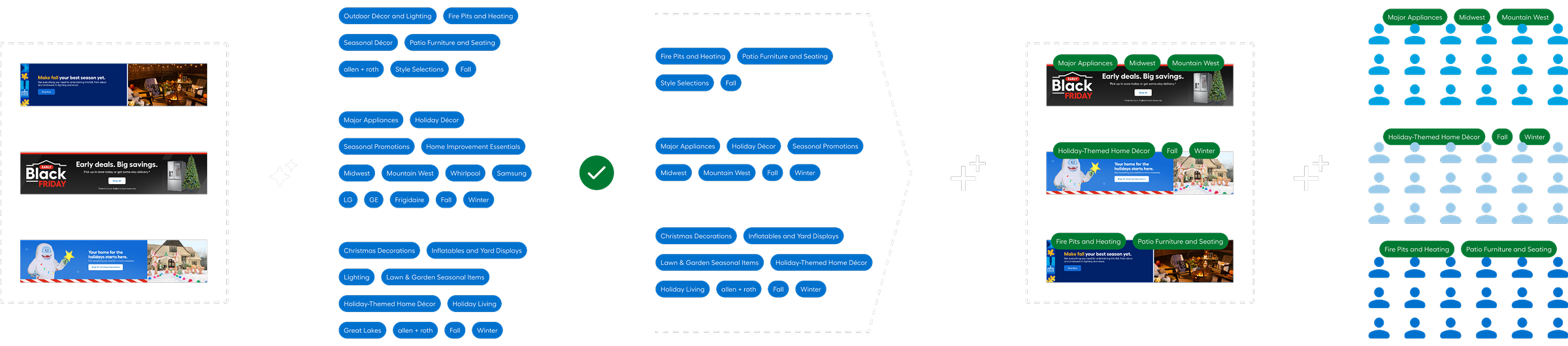
Problem
Lowe's CMS had the ability to target marketing images to different customer affinities (e.g., region, budget, brand preferences), but the process was tedious and manual, so authors rarely used it. Personalized content contributes to a 7.5% increase in conversion, so it was critical to get more targeted content in front of customers.
Goals
The business goal was to use AI to automate content targeting and optimization: AI would analyze each image and generate descriptive tags, which would then power Captain's ability to automatically target images to specific customer segments.
Engineering proved AI could generate accurate tags, but the output required editorial review before Captain could use it — which meant designing a validation flow that wouldn't slow authors down. The design challenge: add a human-in-the-loop review step without adding friction.
Team and Timeline
I was the sole designer on this project, partnering closely with a product manager, an engineering manager, and a team of engineers and data scientists.
The project kicked off in October 2025 and shipped in February 2026.
Gen AI Tagging Prototype
I designed this prototype to illustrate the author's end-to-end flow for reviewing and approving an AI-generated tag set in order to validate it for use by Captain. This flow was designed for:
- Quick task recognition: authors can quickly find assets, understand their status, preview their content, and start their review.
- Scannability: tags are grouped into recognizable categories and stacked, making it fast to scan left to right and top to bottom.
- Predictability: the review layout is designed to be consistent regardless of the size or state of the data set, helping authors go faster by building task muscle memory.
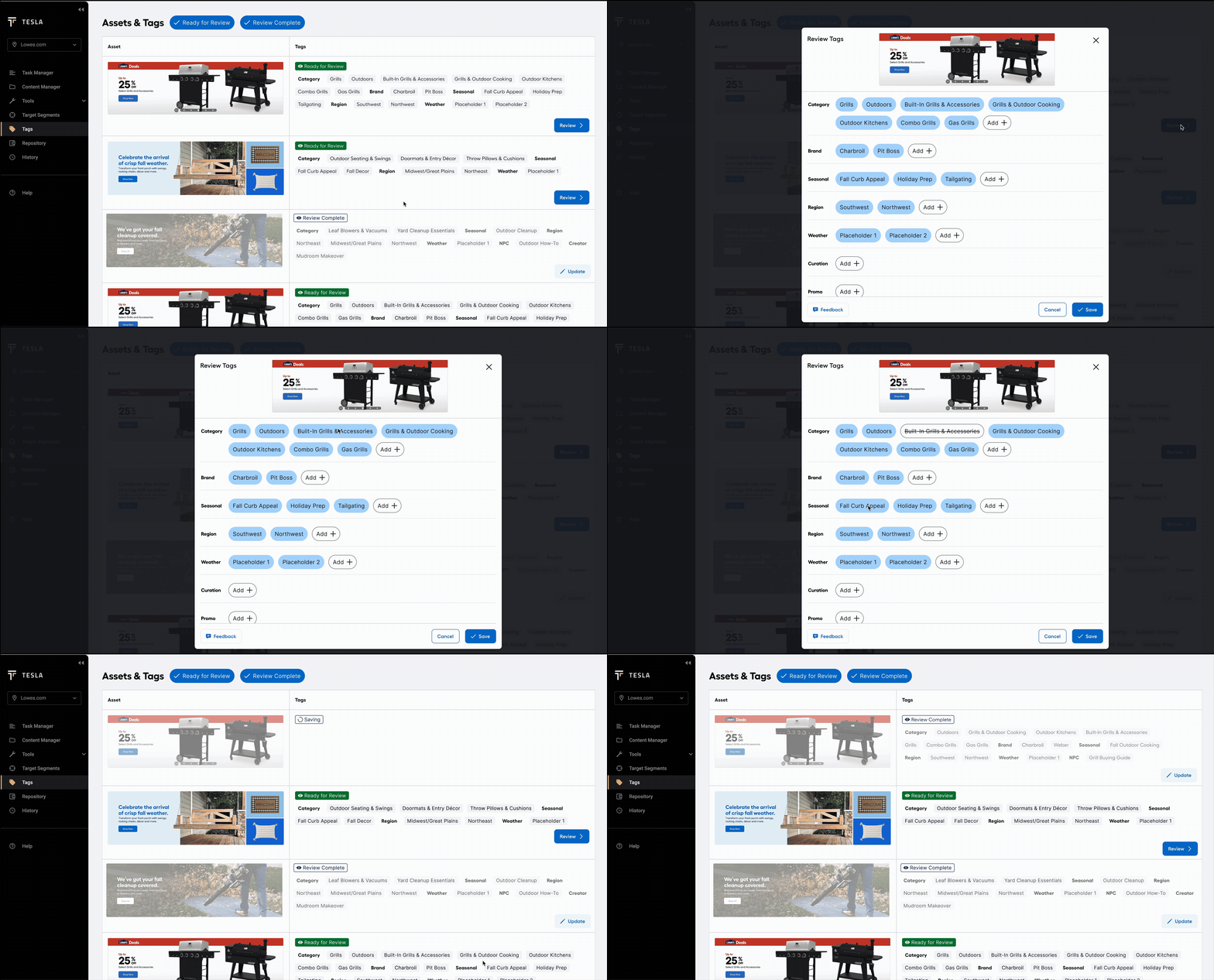
Example of the Gen AI Tagging validation flow.
Captain
Once validated, this metadata goes to Captain: the agentic service that uses validated tag metadata to automatically target content shown to customers. Previously, authors manually configured targeting rules for each image (region, budget, brand preferences) in a three-step campaign setup process. With Captain, authors validate AI-generated tags once, and Captain handles targeting autonomously — reducing campaign setup from three steps to one and increasing the volume of personalized content the platform can deliver.
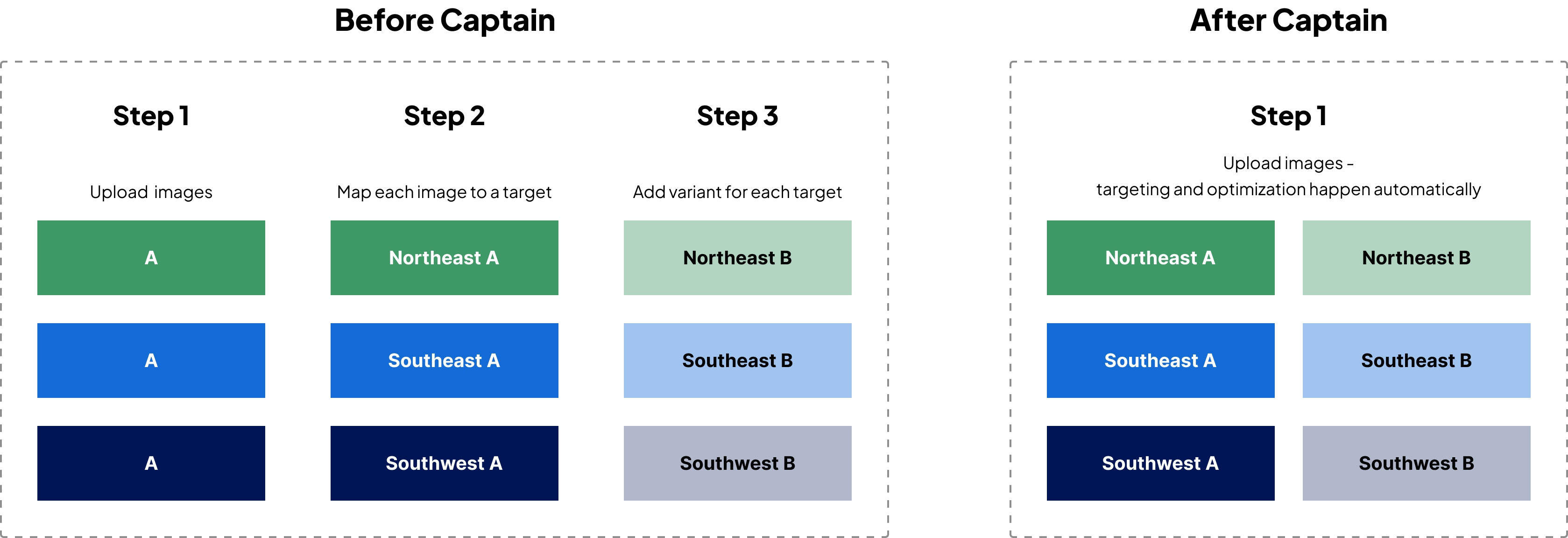
Before and after: campaign set up steps decreased from 3 to 1 because Captain already had validated targeting info via the Gen AI Tagging process.
Executive Presentation
Executive leadership requested a presentation to promote the launches at a company-wide town hall. I designed a narrative that distilled the technical system into a clear story for a non-technical audience, translating Gen AI Tagging's validation flow and Captain's autonomous targeting into "what this means for customers and the business."
Outcomes
Gen AI Tagging and Captain shipped in February 2026 and Captain personalization capabilities were added to the Lowe's homepage hero banner component. Previously, fewer than 10% of homepage banners showed personalized content due to the friction of manual targeting setup. With Captain handling targeting autonomously using validated AI-generated tags, homepage banner personalization can now scale to 100% coverage, making it possible for every customer to see content matched to their preferences.
Personalized content historically drives a ~10% increase in conversions when customers interact with it. Gen AI Tagging and Captain make that level of personalization achievable at scale by removing the manual setup step.